Adell Island Type Fixture Stand
Find the Stand You're Looking For
Filter projects by product type, material, and industry.
A New Perspective on the Category
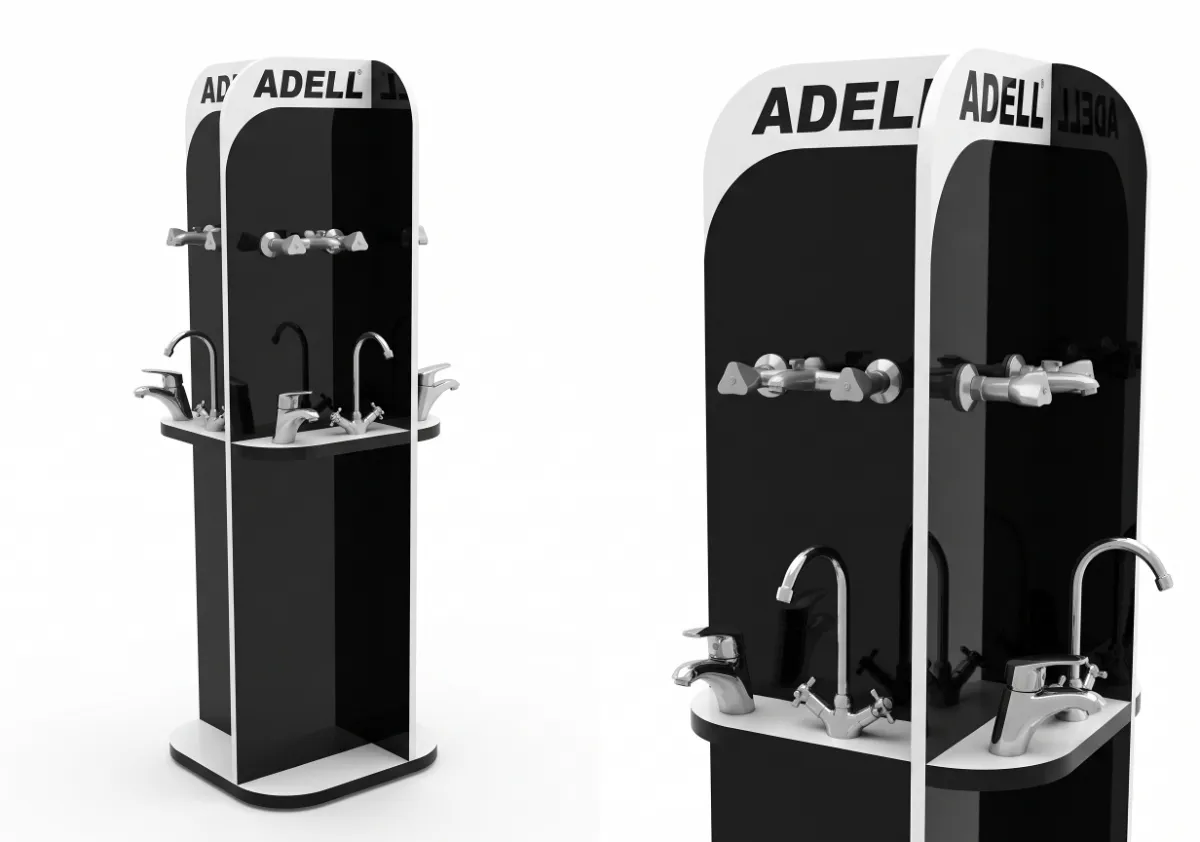
In the sanitary ware category, the technical quality of a product only becomes a compelling experience when the consumer can view it at its actual usage height and from different angles. The starting point of the project was to differentiate the bright metal samples in the busy DIY store environment, maintain four-way access in the island layout, and facilitate product comparison. The design was therefore not treated as decorative furniture, but as a retail medium that unites category management, brand communication, and store operations within a single unit. The layout created for sanitary ware and bathroom accessories conveys the product's function and the reason for purchasing it in an understandable hierarchy. Thus, instead of being a promotional island detached from the main shelf, the stand becomes an active touchpoint that participates in the store flow but establishes a visual boundary belonging to the brand.
The Strategic Backbone of Design
The visual composition is based on a dark, cylindrical island mass, peripheral product placement, and a strong, top-reading brand crown. This choice was made not only for aesthetic reasons but also considering approach distance, viewing angle, product scale, and the brand's position within the category. The upper section supports recognition from a distance, the middle section encourages comparison and product purchasing behavior, and the lower section supports stock security and structural balance. Controlled negative spaces prevent the packaging from blending together, while color blocks guide the consumer's gaze in a specific order. The logo, short benefit messages, and product groups do not compete on the same visual plane; each layer fulfills its own communication function.
Planogram and Field Operation
The merchandising system was built on sample modules that arranged different battery families in an environmental route based on their usage area and design language. The planogram had to be functional not only for the initial setup photo but also for the daily replenishment pace and SKU changes during campaign periods. The ability of staff to quickly replenish products, identify low stock levels, and keep price information in the right place directly impacts field efficiency. The modular design of shelves, hooks, or sample areas allows for the rearrangement of product surface area according to sales speed. This flexibility creates higher category efficiency in a limited square footage while also enabling the stand to be used in different store formats.
The Psychology of Shopper Decisions
From the shopper's perspective, the primary goal is to allow them to assess the product's surface quality, ergonomics, and mechanical feel through touch. The design achieves this not through loud advertising messages, but through the correct sequencing of intuitive cues. The consumer first perceives the brand, then selects the product range that meets their needs; finally, they compare format, features, and price. The reach of the products, the visual space between shelves, and the points where information is presented all support this micro-journey. As the burden of decision-making decreases, purchasing confidence increases; and the brand positions itself not just as a product provider, but as an expert in making the category understandable.
Material, Production and Service Life
The technical solution features a metal internal frame, CNC-machined composite panels, precise sample connections, and high-contact resistant surface coatings. Material selection was evaluated not only for appearance but also for load, impact, cleaning, shipping, installation, and reuse cycles. The serviceability of the connections allows for the replacement of damaged shelves or graphic elements without needing to replace the entire stand. Edge finishes, surface quality, and connection details confirm the brand's claim to quality at the point of close contact. This balance between manufacturability and aesthetics contributes to efficient budget utilization not only during the initial installation but also throughout the stand's entire lifespan.
Production Quality and Commercial Results
The Adell Island Type Faucet Stand doesn't build visibility in the faucet and bathroom accessories category solely on logo size; it builds it through improved wayfinding, more organized product display, and a more secure product experience. Commercial performance can be monitored through metrics such as off-shelf contact count, fill rate, product replenishment time, cross-selling, planogram compliance, and brand block maintenance. By combining the shared goals of marketing and sales operations in a single physical tool, the project differentiates itself from a passive construction that merely carries the product. The resulting stand becomes a long-lasting system that transforms the brand space within the store into measurable communication and sales capital.