

A customer buying spray paint is often looking for more than just a product; they are looking for a specific color, surface effect, and application result. When different product groups—gloss, matte, metallic, fluorescent, or primer—are displayed in the same area, it can be difficult for the customer to quickly compare the options.
Therefore, a successful spray paint stand, It has a task beyond simply stacking boxes on shelves. It must make the product range understandable, simplify color selection, differentiate between different series, and safely transport a large number of metal boxes.
The visual language of the stand should also be consistent with the sector in which the product is used. While an industrial, technical, and robust look is expected, unnecessary design clutter that overshadows the brand colors and product packaging should be avoided. A well-planned display system transforms a wide variety of products into an organized and easily purchasable presentation within the store.
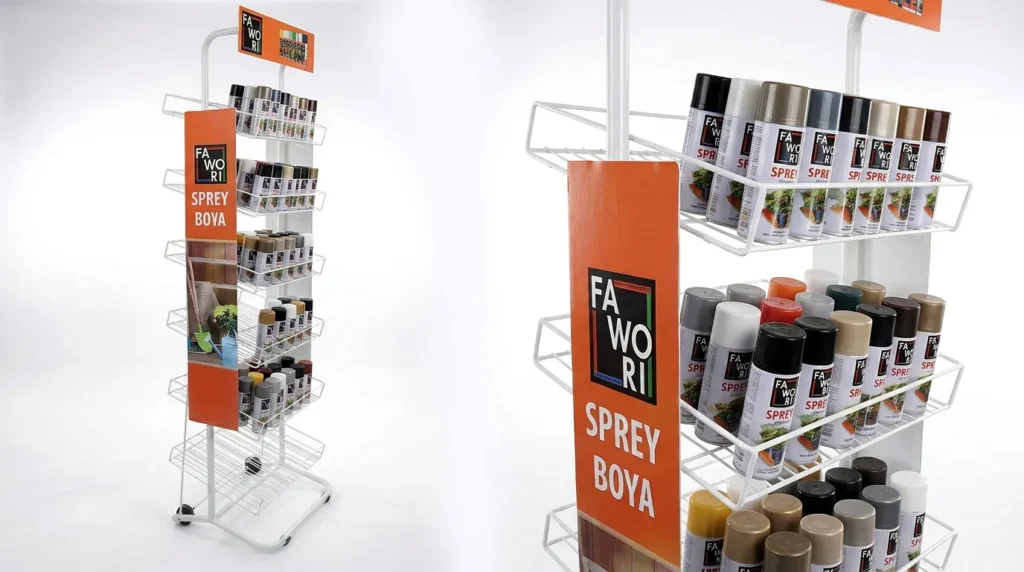
Why does display become more difficult as the number of colors increases?
In the spray paint category, numerous color and surface options can be found within the same product group. When the overall design of the packaging is similar, customers try to distinguish the product they are looking for only by the small color codes on the box or caps.
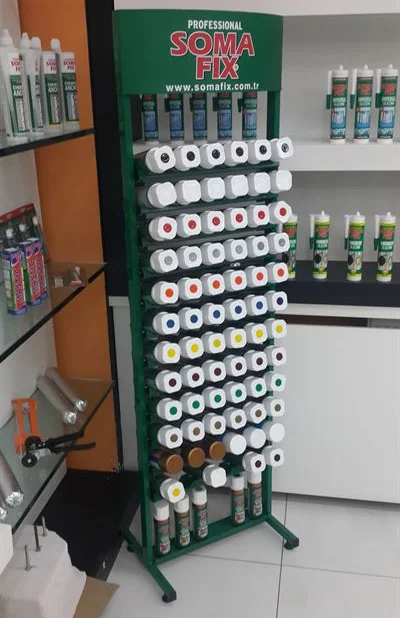
When products are arranged randomly, the shelf quickly becomes cluttered. Similar shades diverge, different product series overlap, and it becomes unclear which row the empty products belong to. This not only creates visual disorganization but also makes it difficult for customers to make decisions and for store staff to restock the shelf.
The layout of the spray paint display stand should be planned before the product range even arrives at the store. The number of different colors, the number of cans of each color to be displayed, and the groups into which the products will be categorized should be among the initial design considerations.

A layout that makes it easy for the customer to find the right product.
The colors should be arranged in a clear system.
Color transitions should follow a logical pattern that makes it easy for the customer to achieve the desired tone. Placing light and dark tones, warm and cool colors, or different variations of the same color completely disconnected from each other makes comparison difficult.
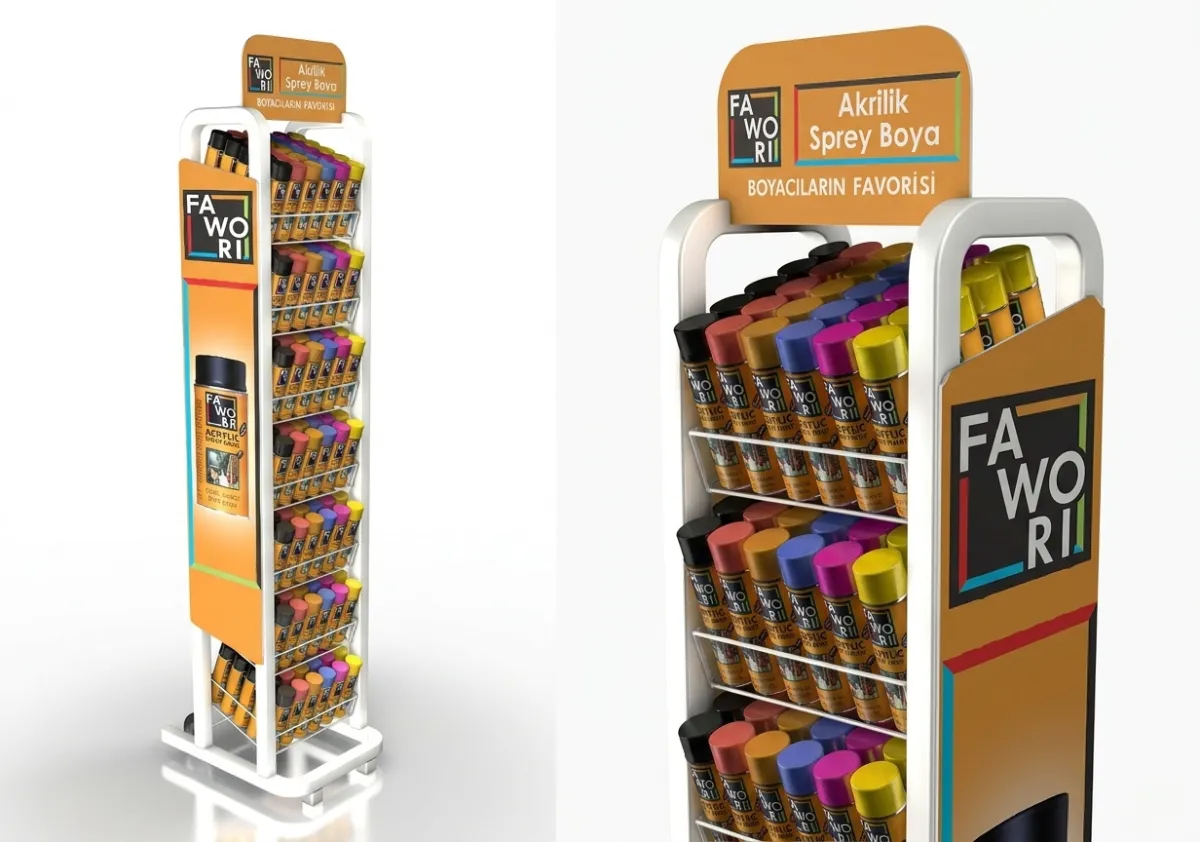
The color scheme on the display should match the actual stock order of the products in the store. A large color palette created purely for visual purposes but not matching the product arrangement can mislead the customer.
Cover and label visibility must be preserved.
Color information on spray paint cans is usually discernible from the cap, top section, or packaging label. Designing shelf fronts that are unnecessarily high can obscure these areas that help identify the product.
A balance must be struck between shelf height that prevents the product from falling and packaging visibility. The customer should be able to read the product type, color, and key features without completely removing the box from the shelf.
Product lines should be separated physically and graphically.
When primers, varnishes, standard colors, metallic paints, or special effect products are sorted solely by color, their different uses can become confusing. Therefore, the product family should be segmented first by function, then by color option.
Shelf labels, small directional headings, and controlled color blocks support this differentiation. However, instead of filling the entire stand with numerous texts and graphics, the information that truly influences the customer's decision should be highlighted.

The stand's supporting structure should be designed according to the product weight.
Although spray paint cans may seem light on their own, the total weight of products arranged side-by-side and back-to-back on a shelf can reach a significant level. The load-bearing capacity of the stand should be calculated not only based on the number of cans displayed, but also considering the situation when the shelves are completely full.
Long shelf spans can warp over time. Weak shelf connections can cause the stand to loosen when moved within the store. Therefore, shelf width, material thickness, connection points, and any metal supports used should be considered together.
Shelf depth should control product arrangement.
Very deep shelves can obscure the products in the back rows and make it difficult for customers to reach them. Conversely, shelves that are too shallow won't allow for sufficient product stock to be maintained on display.
Whether products will be displayed in a single row or in several rows should be determined in advance. By adjusting the shelf depth accordingly, both product capacity and ease of use can be kept under control.
Shelf fronts should prevent boxes from tipping over.
Cylindrical packaging can move around, especially in points of sale where customers tend to examine and haphazardly place products. A metal wire, twisted sheet metal, plexiglass barrier, or similar retaining detail used at the front of the shelf prevents products from falling forward.
This piece should securely hold the bottom of the box in place, but it should not cover the product label or color information.
The base balance should be suitable for heavy use.
Freestanding spray paint stands must maintain their stability even when most products are located on the upper shelves. There should be no risk of wobbling or tipping over when a customer pulls a product from the shelf or touches the stand.
The overall height of the stand, the depth of the base, and the weight distribution of the products must be considered together. Instead of a large base that unnecessarily reduces store space, a balanced construction with correctly calculated load-bearing capacity should be developed.
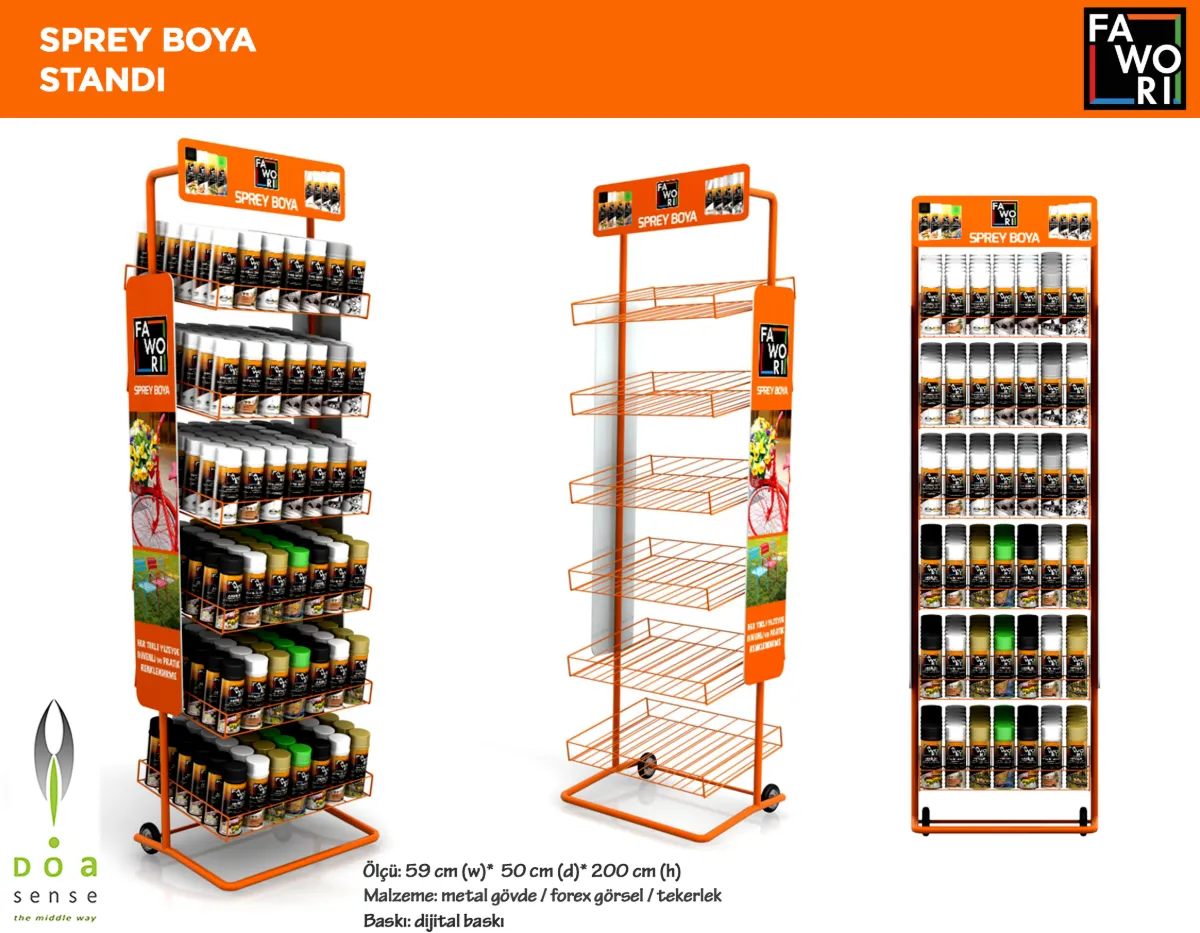
What tasks can metal, wood, and plexiglass perform?
Instead of sticking to a single material at spray paint stands, the powerful properties of different materials can be combined.
Metal construction provides high load-bearing capacity, robustness with narrow profiles, and durability for intensive store use. Electrostatic painted sheet metal, box profiles, or metal wire shelving are particularly suitable for freestanding displays with high product capacity.
MDF and other wood-based panels can be used to create large graphic areas, decorative side panels, floor coverings, and brand-specific forms. The edges of the wood pieces must be properly treated to withstand heavy contact and potential impacts.
Plexiglass can be used to create visual emphasis in logos, wayfinding areas, color schemes, or custom-cut decorative pieces. However, thin plexiglass pieces, which are at risk of breakage, should not be used in carrier areas where they are in constant contact with customers or product boxes.
Material decisions should not be based solely on appearance. Product weight, production quantity, shipping method, store usage time, and target budget should all be considered together.
Three different sales areas, three different booth approaches.
Hardware store and building materials applications
Hardware stores typically have a high variety of products and a large stock volume that needs to be maintained on display. Customers may want to compare technical specifications, and products may be frequently taken from and restocked throughout the day.
In these areas, high load capacity, easy stock tracking, cleanable surfaces, and strong category signage are prioritized. It is also important that the stand does not obstruct the passageway around it.
Hobby and stationery stores
For spray paints used in decoration, hobbies, or artistic applications, color selection is a more visible purchasing criterion. Therefore, the color range, application examples, and the distinction of special effects can be emphasized more strongly.
Stand design can support creative uses while maintaining a technical product perception. However, graphic design elements should not overshadow the products themselves.
Campaign and temporary display areas
In campaigns introducing a new product line or highlighting specific colors, a more compact stand may be preferred. Such applications function less as a replacement for the main aisle and more as secondary display points that highlight specific products.
For promotional stands, quick setup, easy shipping, and placement in a convenient location within the store are crucial features. Even with lower product capacity, the brand message and campaign information should be perceptible from a distance.
Safety requirements cannot be considered separately from design.
The storage and display of spray paint products must comply with the safety information provided by the product manufacturer and the application rules of the point of sale. When determining the location of the stand in the store, heat sources, direct sunlight, electrical equipment, and the store's fire safety regulations should be taken into consideration.
The stand construction should not crush, puncture, or cause product boxes to fall. Sharp edges, protruding connections, and shelf details that put pressure on product packaging should be eliminated during the prototyping phase.
It should be remembered that security is not limited solely to the robustness of the display stand. Store layout and product storage conditions must be evaluated separately in each project, in accordance with relevant product information and point-of-sale requirements.
What information needs to be determined before the project begins?
Designing a successful spray paint stand requires more than just providing the general stand dimensions. The design team needs the following information:
- The diameter and height of the spray paint cans to be displayed.
- Total number of product varieties and colors
- Number of boxes to display for each product.
- Whether the stand will be freestanding, countertop, or in-store.
- Type of store where it will be used
- Maximum width, height, and depth allocated for the stand.
- How to group product lines
- Whether a color scale or application example is required.
- Whether the stand will be shipped as a single piece, semi-assembled, or fully disassembled.
- Production quantity and conditions of sales points where distribution will take place.
When this information is clarified in the initial design phase, product capacity, material usage, and shipping methods can be planned more accurately. This creates a display system that not only attracts attention but also truly integrates into store operations.
Let's develop a functional display system for your spray paint products.
At Doa Sense, we design spray paint stands based on product dimensions, color variety, sales channel, and targeted product capacity. We consider the design, material selection, prototyping, production, and packaging stages together with the actual store conditions where the stand will be used.
A product that simplifies color selection, keeps items organized, and is durable enough for heavy use. spray paint stand You can contact us to develop your project.